The architecture has two loops, one inside the other.
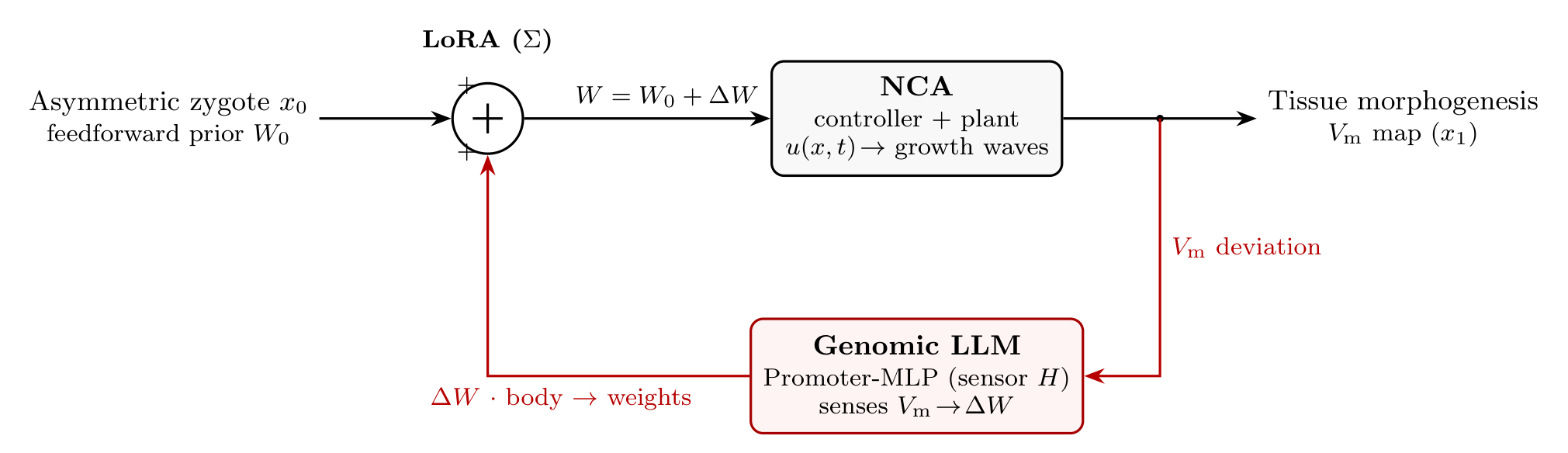
The inner loop: a Neural Cellular Automaton. Every cell runs the same small update rule on its own state and its neighbours’ — the biological substrate of weight sharing. Iterated under deep supervision, the NCA is a tiny recursive reasoning machine: the tissue thinks its way to a shape. The three heads are its readouts.
The outer loop: a Large Genomic Model. The genome is literal sequence — A, T, G, C — read by a frozen encoder into regulatory weights: which enhancers drive which genes, at what strength, in which chromatin context. The LGM does not generate sequence; it converts sequence into the parameters the inner loop runs on. Individual variation enters here as low-rank adapters on the same weights.
The objective: predict the latent, not the pixels. The model is trained to predict the bioelectric membrane-potential field — the compressed latent in which anatomy is specified — rather than to reconstruct every molecular detail. Prediction in representation space rather than pixel space is exactly the JEPA principle, arrived at here from the biology.
Glass box. Unlike a conventional deep network, every layer corresponds to an assay: ChIP-seq measures the attention weights, ATAC-seq the activations, RNA-seq the outputs, patch-clamp the conductances, voltage imaging the latent itself. Run forward from a single cell, the trained model grows a recognizable vertebrate — the demonstration that the architecture is sufficient. See the papers, especially Papers 1, 5 and 6.